The fall of El-Fashir on October 26, 2025 marked a turning point in Sudan’s civil war waged since April 2023. After an eighteen-month siege, the Rapid Support Forces (RSF) seized the last major stronghold of the Sudanese Armed Forces (SAF) in Darfur and immediately carried out mass killings against unarmed civilians, including the reported execution of hundreds of patients and family members in the Saudi Maternity Hospital.
The massacres revived international attention about foreign interference in Sudan’s war. Much of the narrative frames Sudan primarily as a proxy war between competing regional powers and attention has been directed on the role of the United Arab Emirates (UAE) in supporting the Rapid Support Forces (RSF). Lesser known is Egypt’s support for elements of the SAF, shifting Saudi Arabian and United States (U.S.) calculations, as well as various levels of involvement from Turkey and Iran.
This attention is justified, as regional powers have intensified the conflict in pursuit of their own narrow interests. The UAE’s support for the RSF is driven by its broader regional strategy of cultivating non-state partners to counter political Islam, secure influence along the Red Sea corridor and maintain access to Darfur’s gold. It views the RSF as a reliable proxy force capable of reshaping Sudan’s political landscape in line with Abu Dhabi’s anti-Islamist and security priorities. This has translated into sustained military, financial, and logistical support that has significantly strengthened the RSF’s battlefield capacity.
Egypt has been the primary backer of the SAF. This stems from its long-standing belief that a unified, army-led Sudanese state is essential to protecting Cairo’s national security and Nile water interests. Cairo sees Burhan’s military leadership as a buffer against instability on its southern border and as a counterweight to both Ethiopia and Islamist factions. Although constrained by its economic woes and reliance on Gulf investment, Egypt has provided diplomatic cover and limited military assistance to the SAF to prevent Sudan from fragmenting into militia-led administrations.
Sudan’s catastrophe, however, should not be understood through regional power plays alone. This paints a dangerously incomplete picture in a conflict driven by Sudanese political actors. The country has been locked in cycles of violence for decades because ruling elites repeatedly constructed, empowered and weaponised paramilitary structures against marginalised populations. For decades, the Sudanese elites in Khartoum concentrated economic and political power at the expense of the country’s indigenous peripheries. The wars in the South, East, Nuba Mountains, Blue Nile, and Darfur reflect the same pattern: Khartoum responding to calls for civil rights and equal representation with bayonets, displacement and ethnic cleansing.
General Abdel Fattah al-Burhan, the leader of the SAF, was an architect of Sudan’s state violence under the regime of former Islamist dictator Omar al-Bashir. In the early 2000s, he helped organise the ‘Janjaweed’ militias that evolved into the RSF to carry out atrocities in Darfur to put down the ethnic Masalit, Fur and Zaghawa peoples. After the fall of the Bashir dictatorship, he allied again with the RSF in the violent dispersal of the Khartoum sit-in in 2019, killing hundreds of peacefully protesting civilians. In 2021, he and the RSF leadership jointly staged the coup that destroyed Sudan’s democratic transition and would lead to the current war. As global attention focuses on RSF atrocities, violence continues in SAF-held areas. Civilians from historically marginalised regions are being targeted based on ethnicity or regional origin; homes on city outskirts are being demolished, and people are being detained or disappeared.
Sudan now resembles a Libya-style dual-authority system with rival political administrations claiming legitimacy. The RSF has established a parallel governing structure known as ‘Tasis’ (the foundation), supported by a coalition of political and armed actors who broke from earlier peace arrangements. A key component of this bloc is the Sudanese People’s Liberation Movement – North (SPLM-N), whose longstanding demand for a secular, decentralised Sudan has aligned tactically with the RSF’s claim to represent an alternative centre of power. They are joined by Darfuri factions from the Juba Peace Agreement and political figures previously associated with the Forces of Freedom and Change. Opposite them, SAF has consolidated its own governing authority in Port Sudan. Major Juba Peace Agreement signatories, the Sudan Liberation Army (SLA) under Minni Minawi and the Justice and Equality Movement (JEM) under Gibril Ibrahim have entered political and military alignment with the army. SAF has also integrated a defecting SPLM-N faction into its cabinet.
A third civilian force, led by former prime minister Abdalla Hamdok, positions itself between the two military blocs and continues to advocate for a civilian-led transition that addresses Sudan’s long-standing structural injustices. Critics often point to Hamdok’s January 2024 signing of the Addis Ababa Declaration with the RSF as evidence of partiality. This view obscures the full picture according to multiple diplomatic and media sources, as Hamdok’s Sudanese Coordination of Civil Democratic Forces (Taqaddum) also formally invited the SAF leadership to parallel talks, a proposal the army refused to accept. The resulting imbalance, with Hamdok engaging with the only armed faction willing to meet, has been used politically by Islamist elements of the former al-Bashir regime and by pro-SAF circles to portray him as aligned with the RSF. Nonetheless, Hamdok retains a distinct civilian legitimacy as he was chosen by the revolutionary forces to lead the post-Bashir transition and was subsequently overthrown by the same military elites now claiming to speak for the state. Lacking an armed wing, however, his coalition remains marginalised in international peace efforts that prioritise negotiations with armed actors, not civilian constituencies.
It is within this fragmented Sudanese landscape that the U.S., alongside Saudi Arabia, the UAE, and Egypt – the ‘Quad’ – has launched a coordinated initiative to end the war. If successful, the roadmap for a humanitarian pause, ceasefire, and a transitional framework would be an important step as the only currently viable mechanism that could broker a humanitarian truce for a traumatised and starving Sudanese people. It risks becoming, however, a transactional arrangement that rewards the very actors responsible for decades of conflict in Sudan and risks embedding the fracture of the country into two rival governments. Any agreement must address the deep-rooted political and structural causes, such as the exclusion of historically marginalised populations, the militarisation of the state, and the ethicised governance system that has repeatedly fuelled conflict inside Sudan.
Sudan’s collapse is the result of decades of political dysfunction and historical injustices. Its rulers built a system designed to punish the political aspirations of the most vulnerable. Regional powers are now taking advantage of the fractures that the system created to pursue or protect their geopolitical interests. Unless historical injustices are confronted in the current peace process, the fall of El-Fashir will not be the last time the world watches Sudan burn.
About the Authors
Amad Mohamed is the leader of the Sudanese Australian Advocacy Network (SAAN) and works in public service in Canberra. Amad has also worked in the private and non-government organisation sectors, and for a Middle Eastern diplomatic mission, where he gained extensive experience in international and bilateral diplomacy, trade and investment, and defence relations.
Adair O’Brien is a government relations and advocacy professional in the international development and humanitarian sector. He has a Master of Diplomacy from the Australian National University.
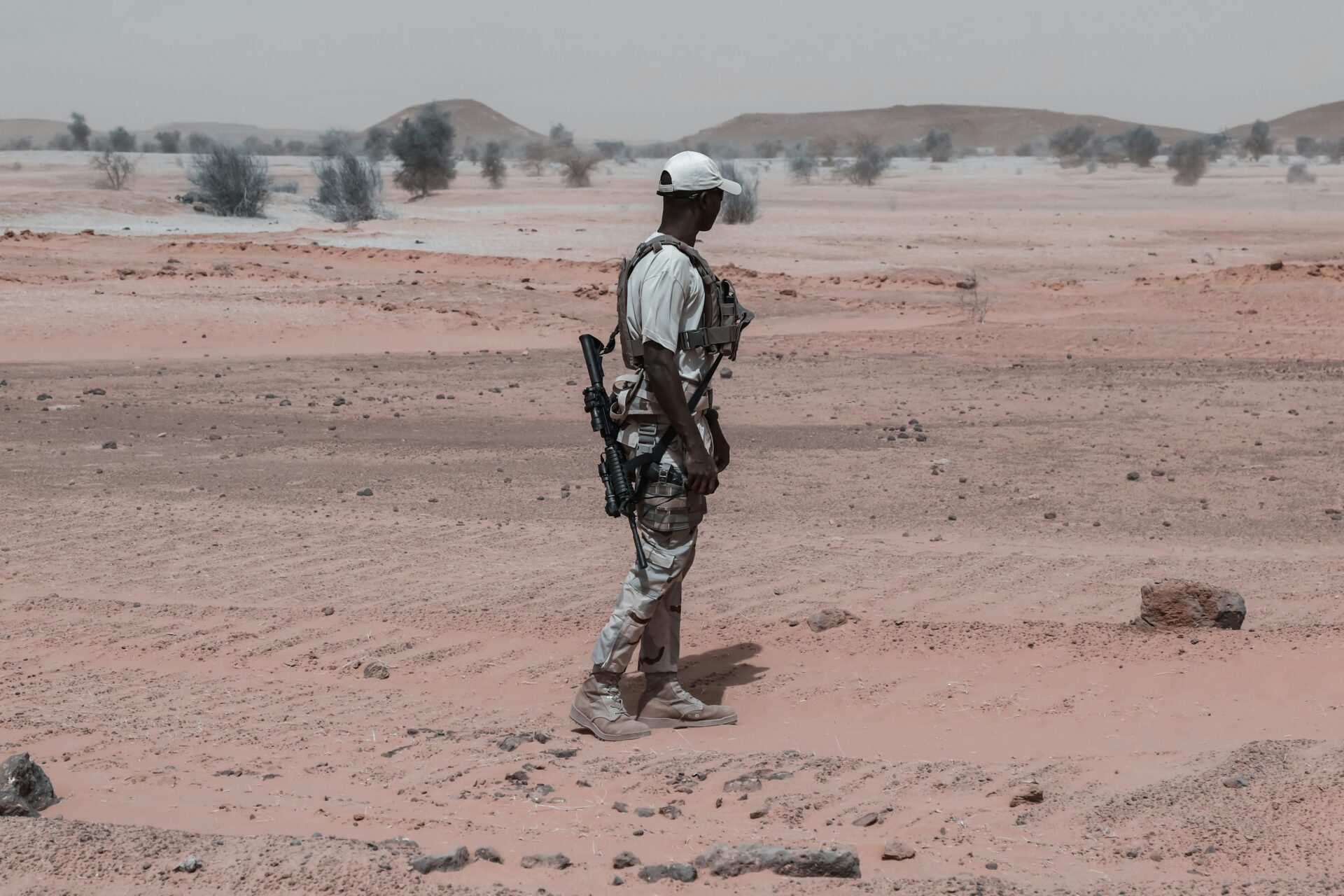
Image by Alexander McKinley on Unsplash
The views expressed in the Near East Policy Forum are those of the authors and do not represent the views of the Near East Policy Forum or any of its partner organisations.